Sunday, 13 July 2014

Aden, Old Deer and the Formartine Buchan Way

Aden Country Park provides a good starting point for a circular walk taking in the park itself, Old Deer, an attractive riverside path and a short but interesting section of the Formartine Buchan Way.
The Mansion House 
 In its heyday Aden was owned by the Russell family. The estate was bought by Alexander Russell of Montcoffer in 1758 from James Ferguson of Kinmundy whose own estates included adjacent Pitfour on the opposite bank of the Ugie. The estate included  the village of Old Deer and extensive farmland which Russell,  an enthusiastic agricultural improver, set about  reorganising  and planting wooded areas to provide shelter throughout the estate. Gradually the  mansion, now merely a shell, was enlarged  and a unique semi-circular steading, coach house and gate lodges were built.  Kininmonth and Ludquharn were added to the estate which at its most extensive covered 31 square miles. Following World War 1 the estate declined and was sold off by last laird in 1937.
The semi circular steading now houses a cafe, museum and theatre


The lake
1975 Banff and Buchan Council began to restore buildings and grounds -established Aden Country Park and Heritage Centre. This now extends to 230 acres of award winning, well maintained parkland and includes a caravan park and camp site, an arboretum, farming museum  and  a sensory garden. The remaining outside walls  of the Russell's mansion have been consolidated and stabilised, an indication of the lifestyle of the lairds is given by the size of the ruins and the nearby  laundry, icehouse and gasworks.


Following the footpaths in the park signed to Old Deer one emerges into the village through a narrow gate in the park dyke beside the Parish Church of Deer and the bridge over the South Ugie Water

 The forerunner of the bridge which carries the road to Mintlaw over the South Ugie was the scene of a foul murder in December 1576 when Thomas Fraser, second husband of Isabel Forbes was murdered by William Gordon of Gight in  a dispute about the inheritance of her previous husband's   Strichen estate.  The wall of Aden Estate, now Aden Country Park, forms the south side of the bridge, a narrow gateway by the Parish Church leads into the park.
A pleasing ecclesiastical jumble in Old Deer, The roof of St Drostan's Episcopal Church in the distance and in the foreground part of the wall of the original Parish Church of Deer and and right angles to that the bulk of the present Parish Church.

Yellow Corydalis (Corydalis lutea) growing on the walls of the ruined church

The ruins of the old Parish Church of Deer and the new parish church, built in 1788-9.

The old church was the site of the infamous rabbling of Deer which took place in March 1711 when the presbytery attempted to replace the deceased Episcopalian minister, George Keith, with the Presbyterian Rev John Gordon and a riot ensued.

The Book of Deer was probably written in the vicinity during the 9th century by the monks of the original Abbey of Deer .

A short distance along Abbey Street a signed path leads down to the Formatine Buchan Way. After following the Ugie, the banks currently thick with  meadowsweet and clumps of purple comfery, yellow monkey flower, pale mauve valerian and dog roses, for a short distance  the Line is reached. 
Bridge carrying the Line over the Ugie
Heading east one can return to the Park either by following a narrow footpath on the right immediately after the bridge carrying the Fetterangus - Old Deer road over the line or at the signed gate where the line crosses the main road. Between the Line and the old fever hospital is a low lying meadow, currently fragrantly blanketed in frothy cream meadow sweet. From this short section of Line Aikey Brae,  Saplinbrae, the  South Lodge of the Pitfour Estate and Cartlehaugh can all be seen.

Friday, 20 June 2014

Mintlaw: the largest village on the Formartine Buchan Line

The railway line skirted the  northern edge of Mintlaw, the largest village on the Formartine  Buchan Line. The station was situated about half a mile to the west of the village, along what became Station Road, and was more convenient for the estates of Aden and Pitfour than for the villages. Housing, commercial and industrial developments have spread from the Station to the village. Currently a new housing development is extending Mintlaw to the north of the Line. The Line passed under the main Fraserburgh to Ellon road which  since the removal of the road bridge it is necessary to cross with care by the Happy Plant Garden and Gift Centre.

 Mintlaw village was established by James Ferguson MP around 1813 at the cross roads of  the  Aberdeen to Fraserburgh and Banff to Peterhead Turnpikes. This was the year in which the stretch of turnpike from Ellon to Fraserburgh was opened. The section of the Peterhead to Banff turnpike which runs through Mintlaw and towards which  James Ferguson, a County Turnpike Trustee, subscribed £300 had been completed in 1807. Stands of trees, particularly beeches dated from this period still line approaches to  the village.

 The crossroads became the centre of the diamond shaped village 'square'  which as traffic has increased has become an uncomfortable hybrid between a traditional  square surrounded by inns and shops and a traffic island.

The Mintlaw War Memorial now stands in the centre of the traffic island, it was originally positioned in front of the Pitfour Arms and commemorates the dead of both World Wars. The cost of the War Memorial, erected after WW1 was met by public subscription which amounted to £242.9s.2d  It has been claimed that the base of the memorial was originally the base of one of the many statues in the Pitfour Estate.


Looking south from the middle of the Square which as always has  attractive floral displays  towards the Pitfour Arms and South Street

  The central position of the village between Fraserburgh, Ellon, Peterhead and Banff made it a convenient place passengers to be given  a break from what was, by modern standards, an uncomfortable and slow journey. In South Street  rest houses were available for passengers to break their journeys but by the 1840s these  superseded by the facilities of the Pitfour Arms Hotel in the Square. For  a time this could claim to be the busiest inn the parish and was the first inn to be built in the village.

The Village Hall on the South side of the Square was built in the late 19th century following a bequest and from local merchant Sylvester Davidson and donation from Charles Farquhar the bank agent. In August 1921 Towards the end of his Lairdship the last of the Ferguson Laird's of Pitfour, George Arthur Ferguson and his wife Nina Maria held belated Diamond Wedding celebrations in the hall. Until very recently  there was been no church in Mintlaw, increasing the importance of the  hall as a meeting place.

Tea time commuter traffic heading along Station Road


Mintlaw was one of the communities to benefit from the generosity of James Mitchel, factor at Pitfour who left a bequest for the establishment of girls' schools in local communities including Mintlaw. The Mintlaw school was functioning by 1840, the mistress was provided with a two storey house and an annual salary of £15. Mitchel also provided a house for the master of the parish school. Mintlaw Primary School with its distinctive checked frontage, originally a junior secondary school,  opened on Longside Road in 1962 replacing an older school on Station road. A second new  school, Pitfour Primary School opened in 1978 and Mintlaw Academy opened in 1981.


Wednesday, 11 June 2014

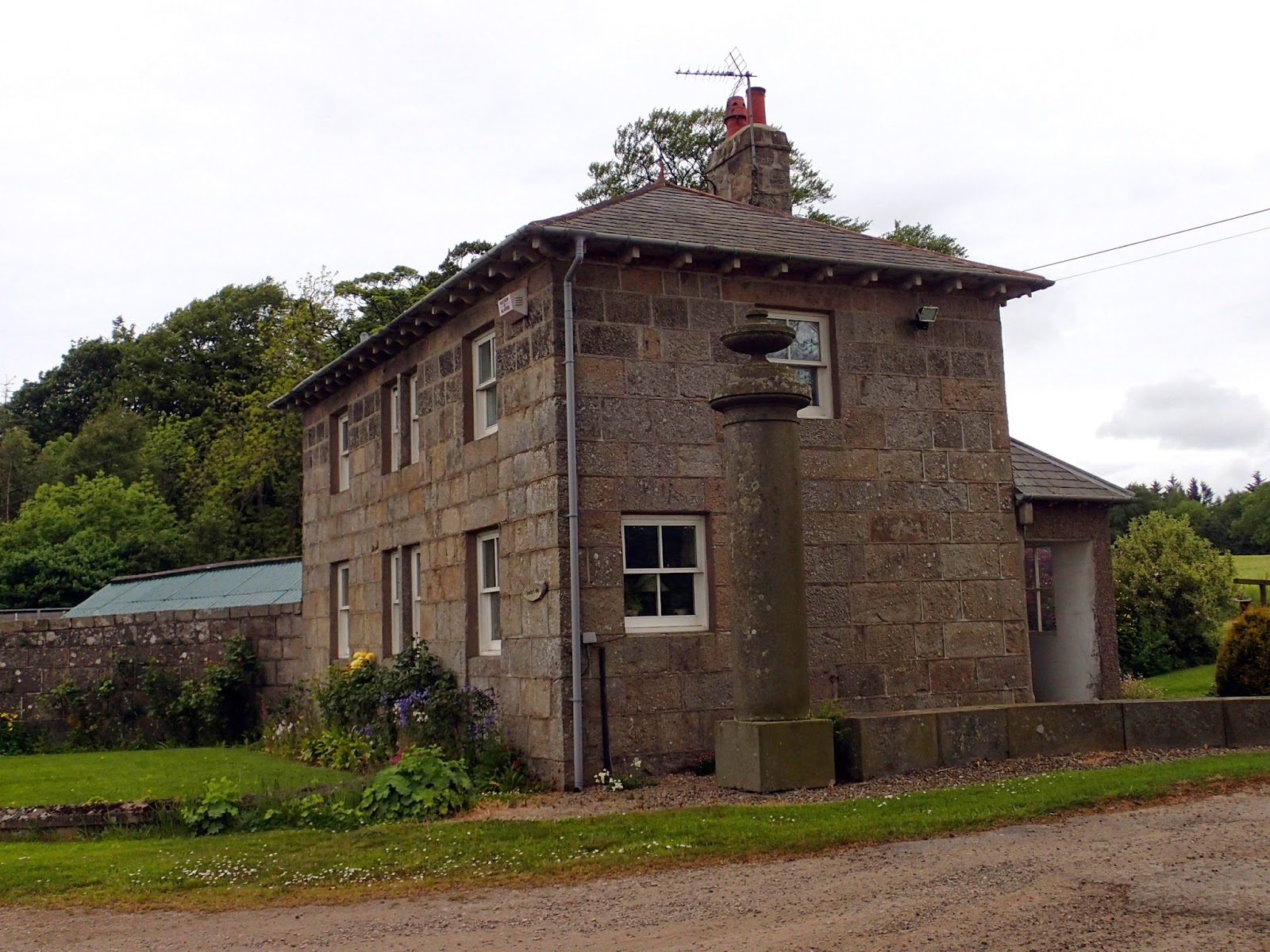
South Lodge Pitfour

South Lodge from the Line

Seen from the Line the Lodge looks like a displaced council house and was infact almost certainly two semi-detached houses when it was originally built around 1850. The Lodge was extensively altered around 1910 and is now a single dwelling.
 

 Although this was the main entrance to the estate the lodge and imposing gateway were not constructed until about 1850 about thirty years later than the West and East Lodges
As befits the principal  entrance the gateway is  impressive. Incorporated in the entrance is an impossing memorial to   William Pitt, The Younger and Henry Dundas, Viscount Melville, two close parliamentary  friends of James Ferguson MP, 3rd Laird of Pitfour.  The monument consists of two granite pillars topped by Grecian urns flanking curving, low walls bounding the entrance. A large stone panel on the east side of the entrance has a Latin inscription commemorating Pitt and Dundas. This translates as 'To the memory of William Pitt and Henry Dundas, Viscount Melville. Men of ancient virtue. This tribute, from the most durable native granite -than which their fame shall be more lasting - is given by James Ferguson of Pitfour, in the year of Salvation, 1816'.

The wall bounding the estate is  over 5 km long and in places 2mtres high. It  was built at the behest of  James Ferguson MP probably to give employment to his tenants during periods of hardship.


Crimonmogate

Crimonmogate takes its name from a combination of  Gaelic and  Old Norse words which mean ' road through the pasture by the peat moss' said to refer to an ancient track across the estate which originally formed part of the vast lands owned by the Earl of Erroll.
 Crimonmogate is a good example of a classical Regency mansion set in extensive policies. The house, designed by Archibald Simpson,  was commissioned in 1820 by Patrick Milne, a highly successful businessman, who became enormously wealthy as  a result of enterprises in the West Indies, India and China. Milne died before the completion of the house in 1825  and it passed firstly to his relation Sir Charles Bannerman then to  the Carnegie family who lived there until the mid 1900s.

The mansard roof and round headed dormer windows which detract from the lines of the original classical design were added in around 1860


A modern  aerial sculpture representing a trapeze artist balances on  a line between trees in front of the house.

 Beech hedges and mature woodland screen the house from outwith the grounds. During the season shooting parties  heading for Crimonmogate  regularly arrived by train at Lonmay station where  there is a large turning area to accommodate  horse drawn carriages and coaches. Only the trees can be seen from the Line.

 The round sundial, positioned  in front of the house, is dated 1780 , the capital is decorated with Prince of Wales feathers.


This obelisk, dated 1821 was erected by Charles Bannerman in memory of Patrick Milne

During WW2 the head office staff of the Consolidated Pneumatic Tool company were evacuated from London to Fraserburgh and were billeted at Crimonmogate and nearby Cairness. Sasha Carnegie's book 'Pigs I Have known', describes a post war pig keeping venture at Crimonmogate. Christopher Monckton, a cousin to the Carnegies adviser to Margaret Thatcher and  inventor of the board game Eternity lived here  from 1996 - 2000. Monckton offered  a prize of 1million pounds for what he thought was his virtually insoluble board game Eternity. Alas the game was solved within  a period of months forcing the sale of the house.

The yurt in the grounds is used for weddings and other events, it is also popular with  swallows

 In 2001 Crimonmogate was purchased by William and Candida, Viscount and Viscountess Petersham who carried out extensive restoration and now run a successful wedding and corporate events business from the property.

Wednesday, 4 June 2014

The former Old Deer Fever Hospital

A short walk from Pitfour along the Line from Taitswell towards Deer Abbey in search of the old fever hospital led to an interesting digression, the discovery of  a badger sett and a circular walk through Pitfour to our starting point. There are several possible circular routes in this area involving attractive walks along the Line and digressions through Aden Park, Old Deer or Pitfour Estate. All are worth exploring, especially by those who dislike 'there and back'  walks for which the Line is often criticised by the unobservant who do not notice how different the coutryside looks when heading in the opposite direction. 

Hawthorn on the embankment close to the bridge carrying the B9030 (Stuartfield) road over the Line. There is a path leading to Aden Park, and Old Deer adjacent  to  the bridge. Crossing the Line the path leads up to the South Lodge of Pitfour and continues within the estate.


Fox-and-cubs or Orange Hawkweed, (Hieracium aurantiacum) grows on the drier section of the permanent way beyond the bridge. Other less striking yellow hawkweeds, flowers of mid summer are also starting to flower. 

A short distance to the west of the bridge in a damp meadow between the the Line and the A950 is this cottage, now enlarged but originally a small 'fever hospital' serving Old Deer.

For a brief period between 1884 and 1906 the small cottage, since extended, operated as a tiny fever hospital. The hospital which only had a handful of beds was situated here to be outside the village but conveniently close to Mavisbank, at that period the home of the Old Deer doctor. Most patients admitted to the hospital would have been suffering from scarlet fever or typhoid fever. The hospital was far too small to handle the number of patients needing to be isolated if there was a major outbreak of an infection and thus closed in 1906, by which time a larger isolation hospital had been opened in Strichen.

South Lodge Pitfour from the Line. The pillar to the right of the Lodge is one of  a pair flanking the main entrance to the estate which form part of a memorial to William Pitt the Younger and Henry Dundas, Viscount Melville.

The former isolation hospital, now modernised and extended.


A network of meandering footpaths has been constructed leading from Old Deer along the bank of  the Ugie, crossing the Line then wandering round the damp, low-lying,  meadow on the north side of the Line. The path eventually leads to Saplinbrae and the Pitfour Estate. The bank just visible in the trees on the far side of the meadow which is home to badgers. The burn which flows through the area carries the outflow from the artificial lake of Pitfour down to the Ugie.
Entrance to a badger sett in the embankment
Looking across the field with the footpaths towards  the old fever hospital  in the middle distance and beyond it the South Lodge. The field has large quantities of damp loving plants such as fragrant meadowsweet, spearwort, pink spikes of  bistort and pale mauve cuckoo flower.


Saturday, 17 May 2014

Royal Saloon at Rathen Station


This photograph was taken at Rathen station on 14th July 1955 and shows the former GNSR Royal Saloon which, having come down in the world, is doing duty as an inspection carriage. It is being hauled by 'Bantam Cock' one of the few steam engines on the Line to have been given a name.(David Toulmin writes of engines 'Lord Saltoun' and 'Earl Marishal' but there is no documentary evidence of their having actually existed.)

Can any one explain?

The Royal Saloon was built at Inverurie in 1898 and was known as First Class Saloon Number 1. It was initially destined to be used for private hire by well heeled travellers. Between  1902 and 1910 the carriage was used by Edward V11, Queen Alexandra and the Prince of Wales, making  its longest journey in September 1903 when it carried the King from Ballater to London. The carriage was saved from scrapyard in 1964 and has been  restored by the Scottish Railway Preservation Society

Rathen Station as it is now, there are the slowly disintegrating remains of a station barrow and weighing machine on the platform 
 

Station lamp bracket

Shiny crane's-bill (Geranium lucidium) on the platform at Rathen

The patch of cowslips on the embankment near the Invernorth Road crossing is an annual delight. These are later to flower than those growing near Deer Abbey where it is more sheltered.
So many violets along the way at present, this seems to be a particularly good year for them.

As we walked the Line between Philorth Halt and Rathen Station we were accompanied by busy, low flying swallows making great arcs over the Line and damp fields, hunting insects and collecting mud for their nests. The sunshine had brought out many small tortoiseshell butterflies which basked on the dandelions.  


Thursday, 15 May 2014

Maud Underpass

The underpass at Maud carries the railway line over a footpath linking Station Road and Deer Road East.
It is flanked by two WW2 pill boxes, one of which can be seen on the right in the picture above. The flaking paint work covering the metal structure has recently been found to contain low levels of potentially toxic lead so the underpass is to be closed to allow for repainting.