Thursday, 10 April 2014

Fraserburgh Station:Now and then

The location of  Fraserburgh Railway Station today, compare with the photograph below which shows the station before closure. The road sweeping round to the right continues along the line of the old tracks.


The very impressive booking hall

Inside the ticket office


The reopening of the station in 1903  following alterations to accommodate the St Combs branch which used the platform on the right

The station with coaches for St Combs waiting under the awning on the right, the locomotive shed is on the left, under the bulk of the South Kirk. The shed is now virtually all that remains and is part of a fish merchants yard. The imposing baronial bulk of the Dalrymple Hall still survives.

Thursday, 3 April 2014

Spring flowers along the Line

Delicate soft green needle clusters opening on larch

The 54 miles of the walkway provide a superb wild life corridor where vegetation is relatively free from management and grows largely undisturbed by agrichemicals. The plants provide food and shelter for a wide range of birds and small mammals. For those who walk sections of the Line frequently the changing vegetation marks the changing seasons and gives each stretch, from the barren windswept miles of the north  to the tree lined stretch through the great estates of Aden and Pitfour in the 'Garden of Buchan' and the gentle rolling countryside of the Ebrie valley its own character.


Gorse along the Line, suddenly the bushes which have carried some sprigs of flowers all through this mild winter are covered in coconut scented flowers. Daisies thrive and have flowered all year round in the grass at the edge of the path, worn short by passing feet.

Coltsfoot with small hairy caterpillar.
The as yet leafless coltsfoot, is now in  flower, the flowers are smaller and paler than the brash dandelions which have also flowered all through the winter. The leaves will appear once the flowers have faded.

Naturalised daffodils give splashes of colour, usually near road crossings and houses. An old friend of Grey Granite recalled that in the days of steam trains when trains were stationary at a certain point outside Strichen the firemen would occasionally get out of the cab to pick daffodils from the embankment. 

Delicate blackthorn flowers

Lesser celandines open and shine in the sunlight. There are great swathes of them on the damp places, ditches and embankments along the Line

Willow catkins


Sunday, 2 March 2014

Tillyeve Crossing

Tillyeve Crossing gates have survived in remarkably good condition and 35 years since the last goods train passed along the Line remain in the open position allowing access to Linkshill. The name Tillyeve  is derived from the Gaelic (Tulach,) a small hill and for  a howl or cry. As befits this rolling countryside,several place names in the vicinity contain the 'Tilly' element.
Gates on the north (Logierieve) side of the Line

Rufus sitting patiently  by the gate on the Newmachar (south) side of the crossing.

Lush June vegetation, the feathery fronds of aniseed scented Sweet Cecily, pink campion and rosebay willow herb growing by the crossing.
Tillyeve Crossing Keeper's House nestles close to the Line, the sign in the window of the modern extension on the right reads 'WHISTLE'

The sleeper built Linesman's hut in remarkably good condition on the permanent wayto the north  just beyond the crossing gates.


South of Tillyeve the Line begins to climb a gradient of 1 in 75 as it crosses between Rennieshill and Whitlam Hill, this saddle is the watershed between the Ythan and Don river systems. 

Monday, 24 February 2014

Strichen Market Place:Rough Justice


Viewed from the embankment which carries the Formartine Buchan Way above Strichen Market Place the grassy space below presents a tranquil scene. Quite apart from the hustle and bustle which must have accompanied the weekly Tuesday markets the Market Place has a far from tranquil history.

In a paper entitled, 'The History of Strichen', delivered to the Buchan Field Club in 1891, Robert Anderson stated that two whale bones used to stand in the Market Stance close to the point at which the railway line crosses it. These bones were used as the town stocks and miscreants such as drunks were reputedly chained to the neck to the bones and subjected to public humiliation. Even more grisly was the nearby chair with along pole attached to it. This was used to ‘dook’ those unfortunates suspected of witchcraft in the waters of the Ugie.  A common test of witchcraft was ‘swimming the witch’; the witch was held under water, those who survived the ordeal were thought to have done so by means of supernatural powers and were deemed to be guilty. Witch hunting in Scotland was most prevalent in the 16th and 17th centuries, in 1597 twenty four ‘proven’ witches out of dozens who were accused of witchcraft were executed in Aberdeenshire alone.  Execution usually took the form of strangulation before being burned at the stake.

The Market Place viewed from the Line

Bridge carrying the Line across the  Market Place, the lane leads towards the Ugie. The bush seen through the bridge is full of catkins. Presumably the market stance extended down to the Ugie before the line was constructed.
Viaduct carrying the Line over the Ugie close to the Market Place. The viaduct supports gave way during  construction. The chair used to duck witches was probably on the right bank of the river in this vicinity.

The land close to the river bank is carpeted with Wood Anemones in Spring. Also known as Wind Flowers, theses delicate beauties were considered, in accordance with the doctrine of signatures, to be a cure for Parkinson's Disease.


Tuesday, 11 February 2014

Railway time along the Line


Logierieve Station building still displays a conspicuous clock
As railways developed across the country and ran according to timetables punctuality and accurate time keeping became essential. Until the need to catch a train arose every community had set its clocks without any regard for what time it was anywhere else. There was no real need to standardise time until trains ran to strict timetables and it was not until 1880 that, after much opposition, Greenwich Mean Time, at first sometimes actually known as ‘Railway Time’, was adopted as the official legal and standard time throughout Great Britain. An immediate result was an upturn in the clock making trade and a rash of easily seen public clocks being added to the outside of churches and public buildings.
Not quite a GNSR engine above the clock on Strichen Station

Such was the importance to the railway system of accurate time keeping, that clocks were a highly visible and important feature of all the stations. Every station had at least three clocks in addition to those in signal boxes. Two clocks, one displayed on the platform, usually mounted high on the wall of the main building, and one inside the building were visible to the travelling public. (Maud had two platform clocks)  There would be at least one clock in the station staff offices. The clocks, supplied by a variety of manufacturers,  were almost always of clear design with a face diameter of about 18 inches. Some stations had special niches in the wall where the clock was mounted, several station buildings which have been converted to houses, including Strichen, Logierieve and Rathen continue to display a clock, presumably in the original position. 

During the 1880s the accuracy of station clocks was ensured by an employee of the clock manufacturer who travelled by train from station to station each week checking and winding the clocks. Such was the importance of the clockman that waiting times of trains at stations could be extended whilst he carried out his duties.The travelling clockman was made redundant by the introduction of the electric telegraph which enabled clocks to be synchronised daily at 10.00 a.m G.M.T. using the telegraph system.  A working time table of 1891 stated that this and the winding of the clock at 8.a.m. on Monday was the responsibility of the station agent.


Friday, 10 January 2014

Rathen Station

Rathen Station.
 The station building has been converted into a house but retains the original window shapes and round the doorway a slight change in the granite indicates where the central glass fronted waiting room has been  blocked up. The road bridge over the line close to the station was dismantled soon after closure. 

A railway barrow remains slowly decaying on the platform.

All that remains of a linesmen's hut just  north end of the platform

Prior to the opening of  the St Combs Light Railway in 1903 creel carrying fishwives from Inverallochy, Cairnbulg and St Combs walked to Rathen Station to catch the train to inland country districts where they went from door to door bartering their fish for farm produce such as eggs, butter and cheese. It was not unusual for between 60 and 70 of them to catch the train the first up train of the day. Their creels were carried free in the guard's van and by  travelling  for a special concessionary fare they were able to extend the range they visited, some going as far as Dyce where they caught another train to stations on the mainline. A Rathen guard described them as being, 'Fully loaded baith wyes'.


The woman were seldom  without their 'wyvin', knitting as they walked the country roads. 

The approach to Rathen Station from the Gowanhill Road. The road crossed the road by means of a long dismantled bridge and the station entrance was a short distance  to the east of the present crossing. The track leads down to the back of the station buildings. Note the cast iron  gate posts,still painted in regulation cream..

Traditional houses in Mid Street, Inverallochy

Looking back over the Line towards Fraserburgh from the Gowanhill road close to Rathen  Station on  a crisp January morning. Note the flooding in the fields on the right, known as Mill Haugh and Wet Fold.
The Formartine Buchan way runs diagonally across the picture disappearing beyond the Fraserburgh Golf Club building. The telegraph poles which were an essential feature of the railway remain along the side of the permanent way.During slack evenings periods the station staff at Rathen and Mormond Halt played draughts over the telegraph.
The trees on the left are the Philorth Woods, the extensive steading of Philorth Home Farm is in front of the wood. The grey roof of Miltown of Cairnbulg  can be seen close to the far side of the Line in front of the Home Farm. On the Fraserburgh skyline the pale rectangular roof top of Fraserburgh Academy is in the centre of the picture, moving to the right the church spires belong to the West Parish Church, St Peter's Episcopalian Church (a squat spire on  a tower) and the South Parish Church.


Wednesday, 8 January 2014

Linesmen's Huts

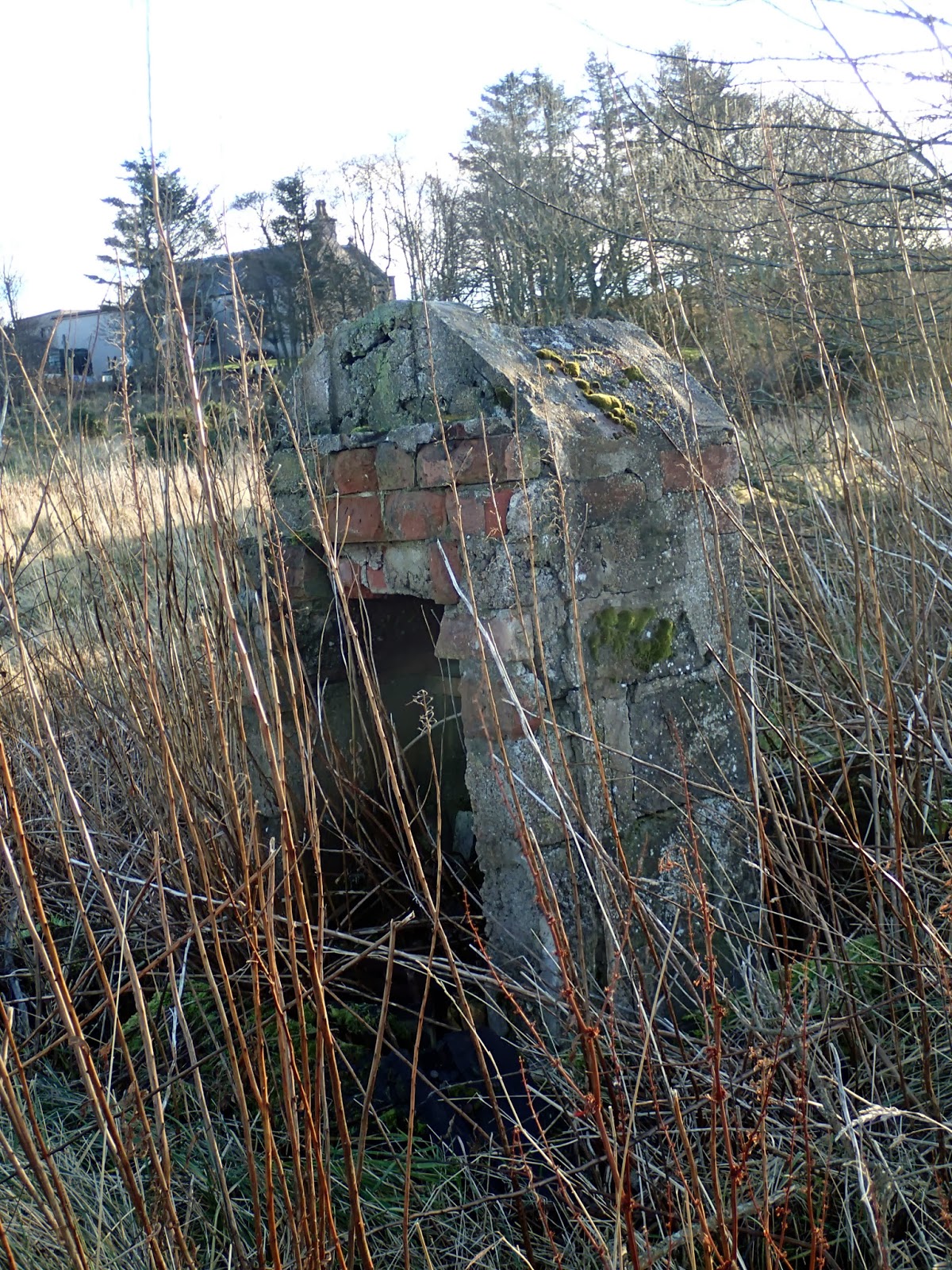
For maintenance purposes the permanent way was divided into sections between 1 and 4 miles long, each the responsibility of an Inspector of Way who had to check the condition of his section daily. Sections were subdivided into lengths, each the responsibility of a foreman who had a squad of two to four linesmen (also known as waymen) working under his supervision. The duties of the foreman linesman were to walk his length of track daily monitoring the condition of the track, bridges, culverts, fences etc and feeding back information to the Inspector. The waymen worked ten hour days in summer, nine in winter and spent their time working systematically along their allotted length of track carrying out maintenance and repairs. The huts in which waymen stored their tools  remain as  attractive features of the line. Earlier huts had wooden walls with a brick chimney stack in one gable and a corrugated iron roof. Later examples are built of reinforced concrete. Apart from one or two examples close to stations which are now doing duty as garden sheds, the huts  are quietly decaying, succumbing to the weather and vandalism. 


Hut between Strichen and Brucklay


The brick fireplace complete with iron grate and  a few rotten floor boards are all that remains of a wooden hut near Rathen Station


Wooden hut near Carnichal

Concrete hut near Greenbrae