Showing posts with label Philorth Halt. Show all posts

Tuesday, 15 January 2013

Philorth Halt:Rosehill Brick and Tile Works

This morning sunshine and a couple of inches of snow transformed the Line and the otherwise winter dreary golf course and fields between Philorth and Fraserburgh into a deserted, magical snowscape.
The line at Philorth Halt, looking down the Line towards Fraserburgh.
 Philorth Halt was built  and maintained by the railway company,  as a private station for Lord Saltoun  as a condition of the line being able to pass through the Philorth Estate.  Although, along with other stations on the line,  Philorth opened in April 1865, the station did not appear on public timetables until   1923 and  was reserved for the exclusive use of Lord Saltoun, his family and factor until 1926. 


The station was built at the point at which the Line crossed the road leading from Philorth Estate to the Cairnbulg road. Part of the  gate of  the level crossing for the road may be seen on the left of the picture above taken looking towards Rose Hill and Corbie Hill from the station.

 Philorth Woods from the Station
Rose Hill with Corbie Hill beyond seen from near the Golf Clubhouse

The small hill on the golf course close to Philorth Halt, where the Philorth road meets the Cairnbulg road, is known as Rose Hill. Writing in 1914 Cranna reports that, 'old men living in Fraserburgh a generation or two ago,  remembered that a brick and tile work was carried on at the Rosehill, the little hill which lies almost opposite the Corbiehill,  on the Cairnbulg turnpike'. The works would have made use of the clay which underlies the bents in this area. A house was built here in 1787 for the Philorth Estate pundlar who along with his duties rounding up stray cattle, seems also to have operated a ferry boat on the Water of Philorth. The hill gives its name to the nine hole golf course which it overlooks.
Corbie Hill, directly beyond Rosehill, is named for the ravens which once flocked there. It in turn gives its name to the 18 hole golf course on the far side of the Cairnbulg road.


Wednesday, 26 December 2012

Philorth by the Loch

The field adjacent to Philorth Halt is currently so badly flooded that the station appears to be by  the lochside.

Waterlogged fields by the Line at Philorth, looking south towards Rathen Station.

Wednesday, 22 September 2010

Philorth to Rathen a new perspective

Grey Granite recently looked at some old photographs of Philorth Halt when it functioned as a station. From these it has become clear that the iron gate  in front of the wooden fence is actually part of the level crossing gate. This gate controlled the crossing of the Line and the access road to Philorth Estate, there is a narrow wooden pedestrian gate beneath the honeysuckle. The ivy clad pillars behind the fence supported the station name.
It was only yesterday that Grey Granite noticed that the skyline of Fraserburgh can be seen from Rathen station and for most of the way as one heads along the Line to the Broch. In the photograph above, Kinaird Head Lighthouse can just be made out on the right close to the tower of the Dalrymple Hall and spire of the South Church.
Red rose hips and sunny stubble fields towards Invernorth

Monday, 23 August 2010

Fraserburgh (Kirkton) to Rathen

Heather, properly ling, (Calluna vulgaris) on the line close to Philorth Halt


Even on a dull afternoon with intermittent attempts at rain there is much of interest even on the dullest section of the Line. There were swallows flying low over the fields, trawling for insects and gathering on the track side telegraph wires. Are they preparing to depart?. Near Rathen station there was fragrant honeysuckle to smell, dog rose hips starting to turn crimson and the flame colours of montbretia growing out of the platform.


Rufus enjoyed looking down on the Afghan hound at Knockmonean, catching small moths and starting a stampede of cattle.

Until 1926 Philorth Halt was a private station for the use of Lord Saltoun. Annabell,  the lady who now lives at the station, was brought up on the Philorth Estate and remembers when it was a working station. In addition to the single platform for passengers there was a goods siding and loading bay for cattle and goods going to and from the estate. This was on the Fraserburgh side of the halt and the platform at which the cattle were loaded may still be seen, the masonary is less well finished than on Lord Saltoun's platform and the level of the bay is slightly higher than the platform. The station had a central waiting room which opened on to the platform, accommodation for the agent, Mr Ritchie at the period Annabel recalls, and his family, storage room for workmens' tools and a small room with a fireplace for the use of railway workers. Annabel remembers travelling to school in Fraserburgh by train during the winter and on 'coorse' days in summer. To catch the train you had to go out on the platform and put your arm out, like catching a bus today. It was unusual for Lady Saltoun to catch the train but when she did so the agent's wife would warm the children to behave. The agent was also employed at Fraserburgh Station.

Cairnbulg Castle seat of the Frasers, Lords Saltoun, was extensively restored in the late Victorian era, as seen looking across the field from Philorth Halt.

Grey Granite was shown several rail 'chairs' which were left at the station when the line was removed.


Cast iron chair with remaining section of line. The small piece of hardwood, called a rail key, was used to wedge the rail in place. The rails were set in the chairs to lean at a slight angle so that the flaring proflie of the flanged wheel sat snugly on the head of the rail.

Cross section of a rail chair, the key would have been on the right.

Grey Granite does not yet know if this is a broken chair or a different type. It still retains the chair bolt with which it was fixed to the wooden sleeper.

Rufus was honoured to be given refreshment at the station and told to help himself in future should he be thirsty.

Friday, 6 August 2010

SUNDAY SCHOOL PICNICS


Grey Granite was talking to a friend who remembered taking the train from Fraserburgh Station to Philorth Halt for Sunday School picnics during the middle years of the 20th century. The excitement included walking down to the station to catch the train for the short, (1.5miles) journey to the halt. Here everyone would disembark from the train, steam in those days of course, and walk to a field in the Philorth Estate. During the afternoon there would be races and games. The picnic food was traditionally a hot pie and a ‘baggie’ containing 3 or 4 fancy pieces. A small glass bottle of lemonade with a ‘crown’ top, which had to be removed with a bottle opener, was also provided.


The train journey to Aberdeen during this period was described as very slow, mainly because the train ‘stopped at every hen hoose’.

Wednesday, 28 July 2010

Philorth Halt


The much altered station buildings and single platform at Philorth Halt

Philorth Halt, 1.5 miles from Fraserburgh Station, was, until 1926, the private station of Lord Saltoun who also had his own private mail bag. Only those who had written permission to use the station from Lord Saltoun could do so.
A special circular issued by the Great North of Scotland Railway to the Station Agent at Philorth and all Guards and Drivers on the Formartine and Buchan section on 1st November 1895 states that;
'On receiving intimation from Lord Saltoun or Sir Alexander Anderson of their desire to alight from or join any of the Mixed Trains passing Philorth Station such train must be stopped, for that purpose, in accordance with the instructions given in the Working Timetable as follows:-

"When there are no Passengers or Goods to be taken up the Agent at Philorth, on the Train whistling, is to bring the Distant Signal to All Right"

"When the Train is required to stop, the Distant Signal is to be brought to action'.
This broken mileage post is between  Fraserburgh Golf Club and Philorth Halt

The pink tinged flowers of Lesser Bindweed, Conolvulus arvensis (above) growing on the line close to the gate to The Dunes, golf driving range between Philorth Halt and Fraserburgh.
David Welch's Flora of North Aberdeenshire describes this plant as being very rare and records only one instance growing at Insch railway yard in 1988. This probably demonstrates the importance of the railway in increasing biodiversity.
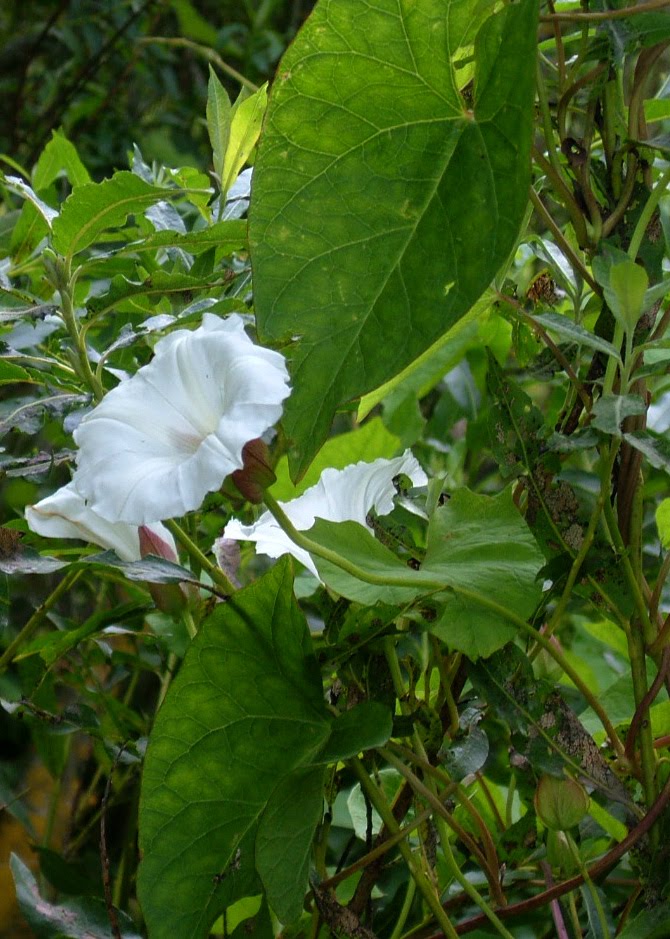
Far more common is Hedge bindweed, Calstegia sepium, (below)whose large white flowers are in the hedge at and on the banks close to  Philorth Halt.

Monday, 5 July 2010

Philorth to Rathen with digression


Grey Granite and Rufus decided to walk from Philorth to Rathen, largely in order to photograph the giant hogweed (Heracleum mantegazzianum) which grows at Invernorth.


There are several enormous giant hogweed plants growing at the roadside opposite Invernorth House, other specimens have been cut down. The remaining plants are currently at least 3 metres high, a native of the Caucasus and South East Asia, hogweed was introduced to Britain in 1893 as  a garden plant but has become naturalised in many areas. The sap is photosensitive in sunlight and can cause persistent skin blisters. The large flowers can produce up to 50,000  seeds a year, these may remain viable for 8 -15 years in the ground. It can form dense colonies which prevent native species growing. Under the Wildlife and Countryside Act of 1981 it is an offence plant or to allow giant hogweed to grow.

The line was fragrant this morning, close to Rathen Station there is a large patch of honeysuckle
(Lonerica periclymenum) tangled in a broom bush and scrambling into the neighbouring field. All along the section dog roses are in flower.
The section of line close to the Water of Philorth has ditches on either side which at present are filled with sweet scented meadow sweet (Filipendula ulmaria), pictured below growing with foxgloves, Mormond Hill in the background.

There were mallards swimming in the Water of Philorth this morning, a heron flew up from the ditch and  a large mixed flock of corvids pecked about on the line, flying up to the telegraph wires in a slightly unsettling Hitchcockesque manner as we passed.